Make your AI systems audit-ready — from day one.
aiceblock structures your AI lifecycle around the AI Act — from risk classification to documented evidence — so you can build, deploy, and prove compliance with confidence.
Try now

aiceblock structures your AI lifecycle around the AI Act — from risk classification to documented evidence — so you can build, deploy, and prove compliance with confidence.
Try now
Classify your AI risk. Know your obligations before you build.

Turn AI Act requirements into traceable evidence.

Keep compliance live, verifiable, and audit-ready.
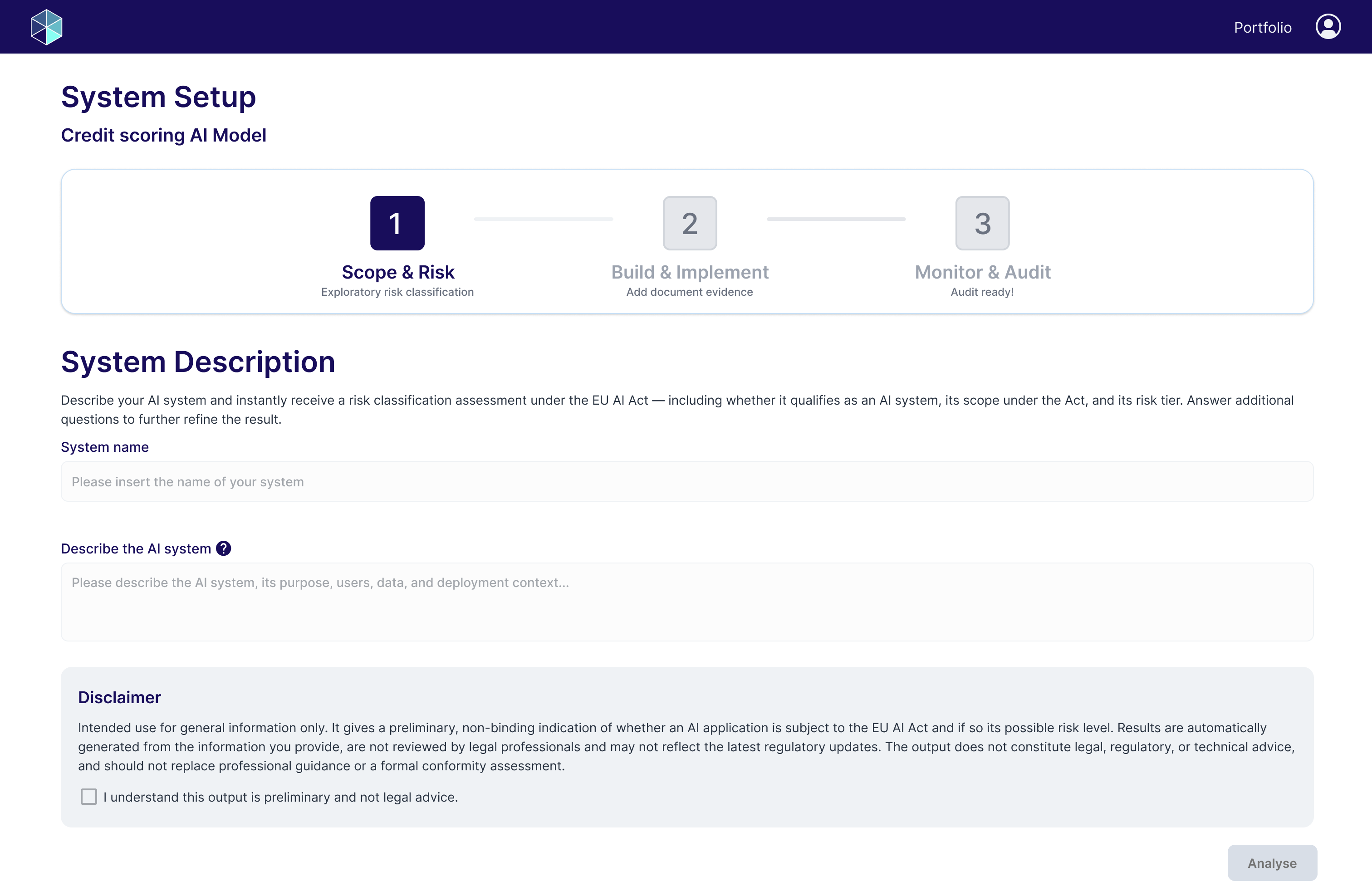
→ Classify AI systems in minutes → Get interpretable AI Act risk assessments → Standardise intake across your AI portfolio → Identify likely obligations from day one → Create a clear baseline for the next compliance steps
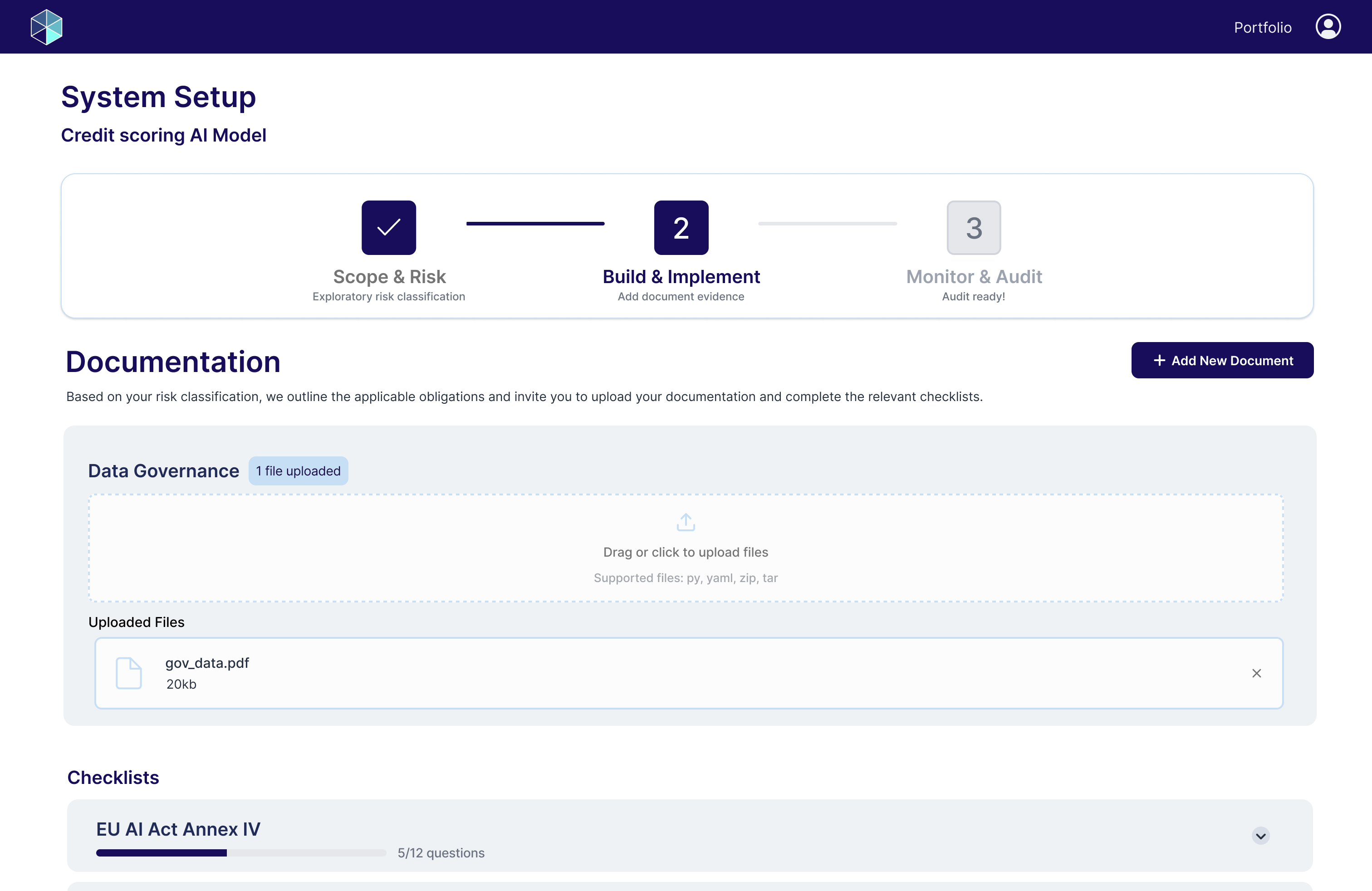
→ Turn obligations into action → Upload evidence where it belongs → Track documentation against AI Act requirements → Close compliance gaps before review → Build a traceable record as you go
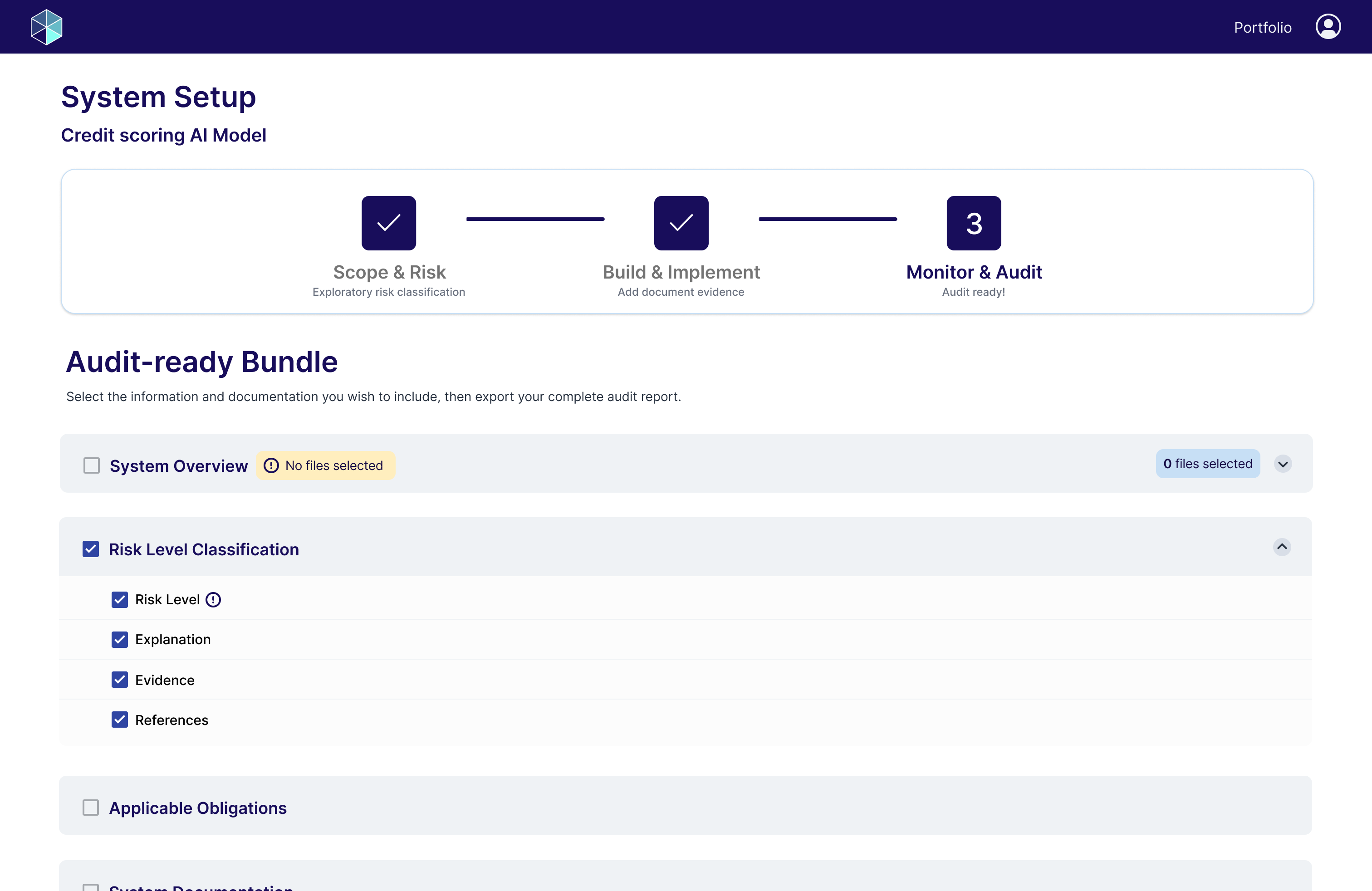
→ Stay audit-ready at all times → Export proof, not just paperwork → Turn records into audit-ready reports → Reduce audit friction with structured evidence → Bring everything together in one bundle
Classify your AI risk. Know your obligations before you build.
• Multi-solution registry • AI Act exposure determination • RAG-based risk classification • Rule-based classification engine • Role-based obligation mapping • Exportable Scope & Risk report
• Conditional obligation logic • Enhanced explanation transparency • Improved dependency mapping • Cross-regulation mapping (e.g., GDPR, sectoral frameworks)
• Advanced mitigation planning • Organization-level compliance profiling • AI-assisted guidance through private/local LLM
Turn AI Act requirements into traceable evidence.
• Obligation-level checklists • Annex IV, DPIA, FRIA templates • Document upload per obligation • Readiness/completion dashboard
• Obligation-to-evidence traceability matrix • Governance workflow and approval tracking • Advanced reporting and structured documentation • Metadata extraction from source artefacts
• Obligation-to-code traceability • Automated compliance validation layers
Keep compliance live, verifiable, and audit-ready.
• Evidence register • Exportable audit-ready compliance package • Third-party certification authority timestamping
• Enhanced audit trail logic • Periodic compliance review scheduler • Third-party evidence snapshot registry
• Monitoring plan builder • Deviation logging and structured investigation records • Automated compliance alerts • Verifiable compliance statements • Pre-built AI Act aligned test templates

Prepare and maintain audit-ready documentation aligned with the AI Act.
Ensure transparency, traceability, and accountability of AI systems.
Maintain a clear inventory and documentation of AI systems.
Find the answers to your main questions here.

aiceblock is an AI compliance management platform designed to help organisations structure, document, and demonstrate compliance with the EU AI Act. It supports the full AI lifecycle — from initial risk classification to audit-ready evidence. aiceblock provides a solution to organise requirements, track progress, and maintain evidence, ensuring nothing is lost or overlooked. This addresses a common challenge faced by many organisations as until now no other solution has offered a comprehensive and structured way to manage compliance over time.
aiceblock does not certify or guarantee compliance. It provides a clear, step-by-step framework to guide organisations through the AI compliance process. It helps you organise information, understand applicable requirements, and document your approach across three stages: Scope & Risk, Build & Implement, and Monitor & Audit.
aiceblock uses AI-assisted features to support risk assessment, including the use of third-party large language models such as those from OpenAI. When these features are used, certain user-provided inputs may be processed by third-party providers in accordance with their own data-handling policies, but ensuring this data is never used for training purposes. Nonetheless, organisations should avoid submitting sensitive or confidential information unless they are comfortable with how it may be processed.
You can register and start using the trial version of aiceblock directly. It provides access to core functionalities for managing a single AI solution. For organisations interested in extended capabilities, it is possible to apply to the pilot programme, designed for organisations looking to use aiceblock in a more structured and scalable way. The pilot programme allows: • Managing multiple AI solutions • Access to additional features • Closer interaction with the aiceblock team Participation requires direct contact and onboarding, but no integration effort is required.
aiceblock follows a structured flow: 1. Register and describe your AI solution 2. Assess risk and identify applicable requirements 3. Document your approach and upload supporting materials 4. Organise evidence and prepare for internal or external review The platform supports each step with built-in guidance and structured workflows.

© 2026 aiceblock. All Rights Reserved.



Designed for providers, deployers, and compliance teams, aiceblock is an initiative promoted by INCM, Fraunhofer Portugal, and VdA.